Dynamical Data Routing
Dynamical data routing allows updating measurement values in a datastates without requiring a fixed assignment to a connector or a virtual device. This enables more efficient rollout and transition processes.
A key advantage of this approach is the ability to provision datastates in the Digital Twin in advance without knowing the associated sensor at the time of provisioning. This simplifies scalability and flexibility when commissioning devices.
Implementation is carried out using a reference ID that serves as the receiving address of the Digital Twin. Within the connector or virtual device, only this target address is stored or modified as needed. Measurement values are then automatically forwarded to the corresponding Digital Twin.
Dynamical Data Routing Connector –> Digital Twin
Data can be sent directly from a connector to a datastates with the source Dynamical Data Routing.
energy: 23,
volume:11|DT subgraph DT[ Digital Twin] subgraph DTMETA[ Metadata] a1[ Reference Id --> refKey: 42] end subgraph DS[ Datastates] direction RL id1[energy] id2[volume] end end subgraph CON[ Connector] c1[Webhook / MQTT] end
[
  {
      "routing": {
          "refKey": "42"
      },
      "variable": "volume",
      "data": {
          "value": 11,
          "time": "2025-03-21T10:45:04Z"
      }
  },
  {
      "routing": {
          "refKey": "42"
      },
      "variable": "energy",
      "data": {
          "value": 23,
          "time": "2025-03-21T10:45:04Z"
      }
  }
]
- With
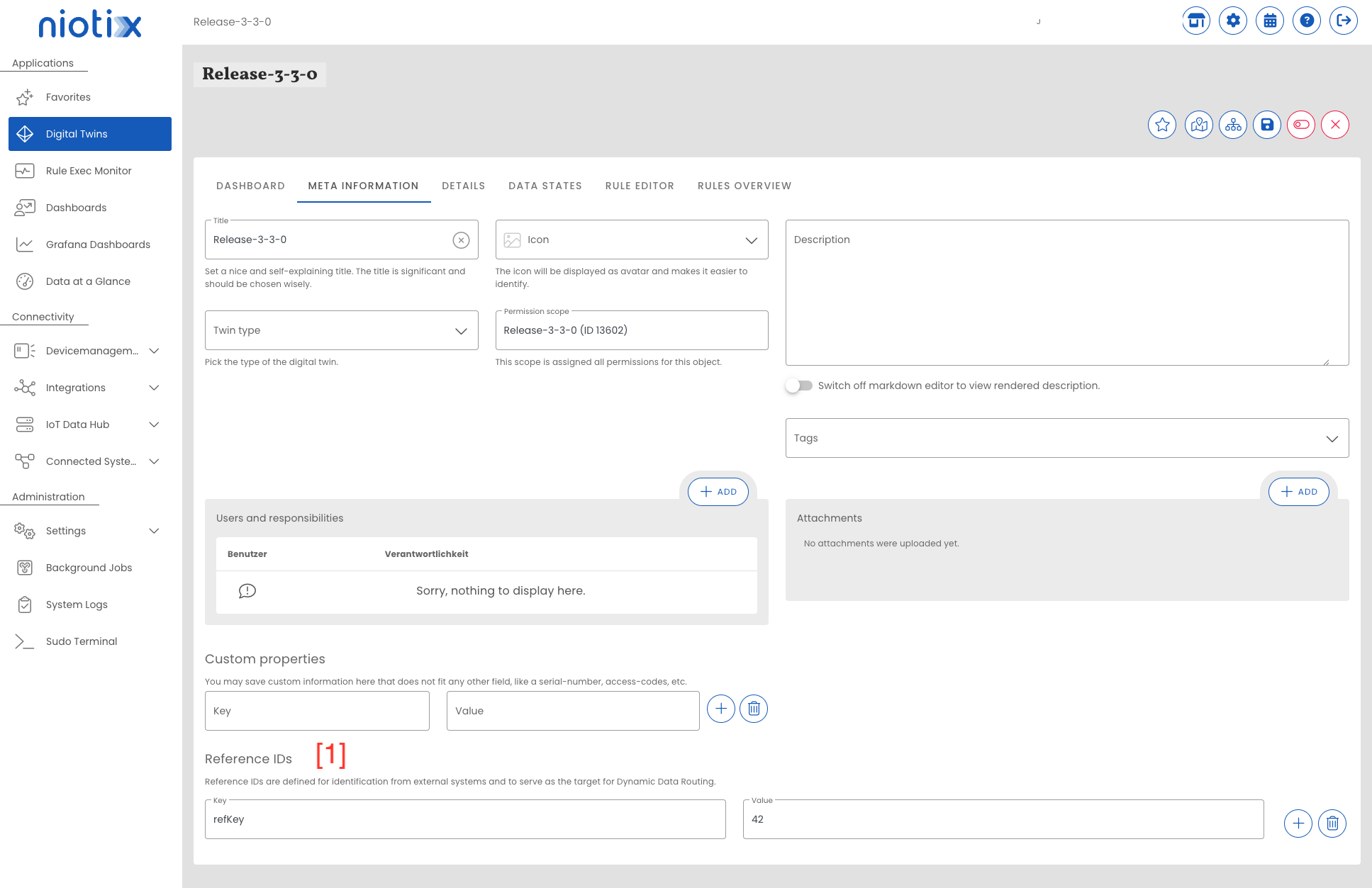
routing, one or more Digital Twins can be addressed using the combination ofreference ID key&reference ID value. See[1] - The
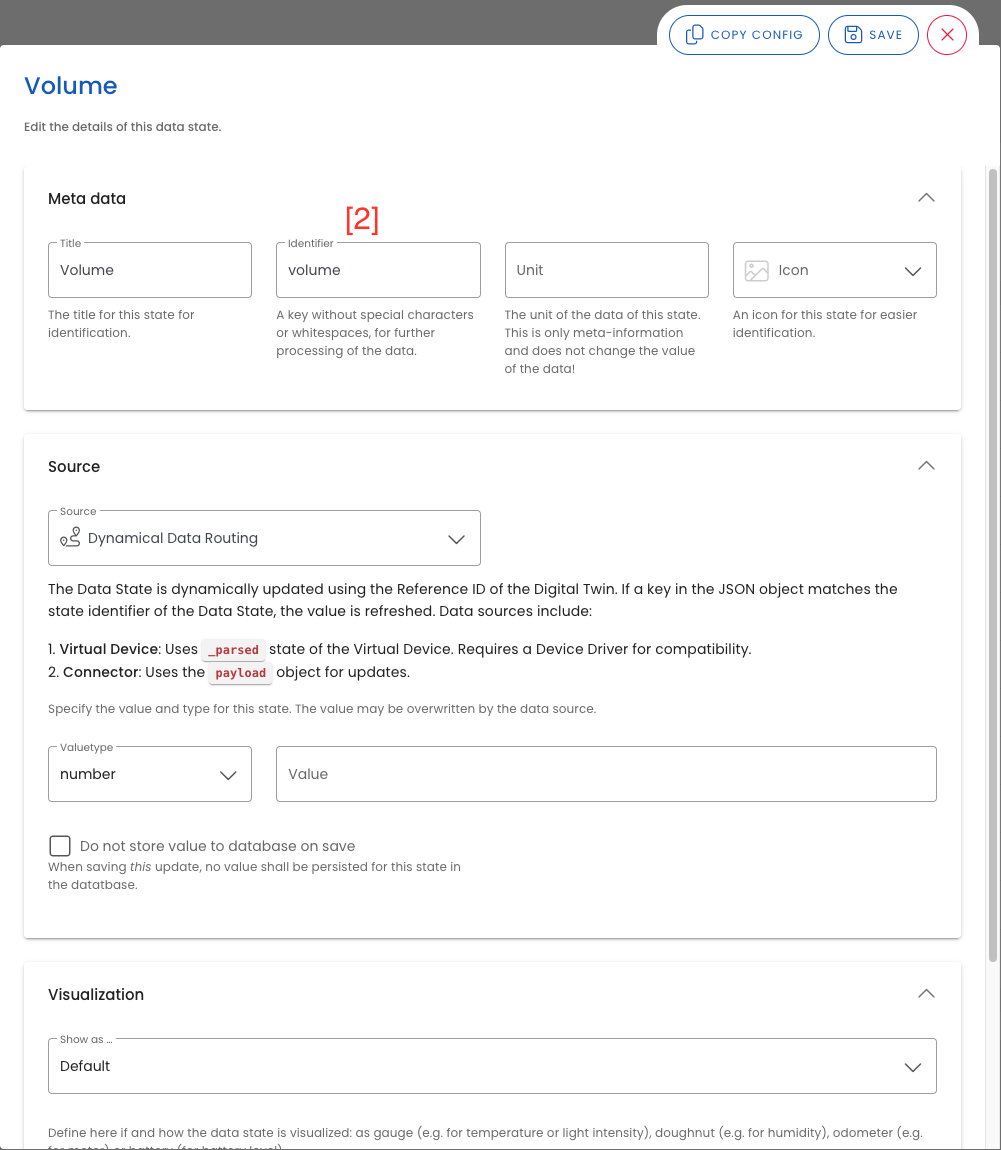
variablemust match the key of the corresponding datastates. See[2] datacontains the informationvalueandtime:valuecontains the measurement value to be written to the datastates.timecontains the timestamp for the measurement value. If this parameter is not set, the current system time is used.
The reference ID key & reference ID value are stored in the Digital Twin in the metadata:
In the datastates, the variable is stored in the “Key” field:
Dynamical Data Routing Virtual Device –> Digital Twin
In dynamical data routing from a Virtual Device to a Digital Twin, data from the _parsed datastates is sent to the addresses stored in the Data Routing tab. The addressed Digital Twins must then have appropriate datastates with the source Dynamical Data Routing.
energy: 23,
volume:11|DT subgraph VD[ Virtual Device] subgraph VDROUTE[ Data Routing] vda1[ Reference Id --> refKey: 42] end subgraph VDDS[Datastates] Parsed["_parsed: { energy: 23, volume: 11 }"] end end subgraph DT[ Digital Twin] subgraph DTMETA[ Metadata] a1[ Reference Id --> refKey: 42] end subgraph DS[Datastates] direction RL id1[energy] id2[volume] end end
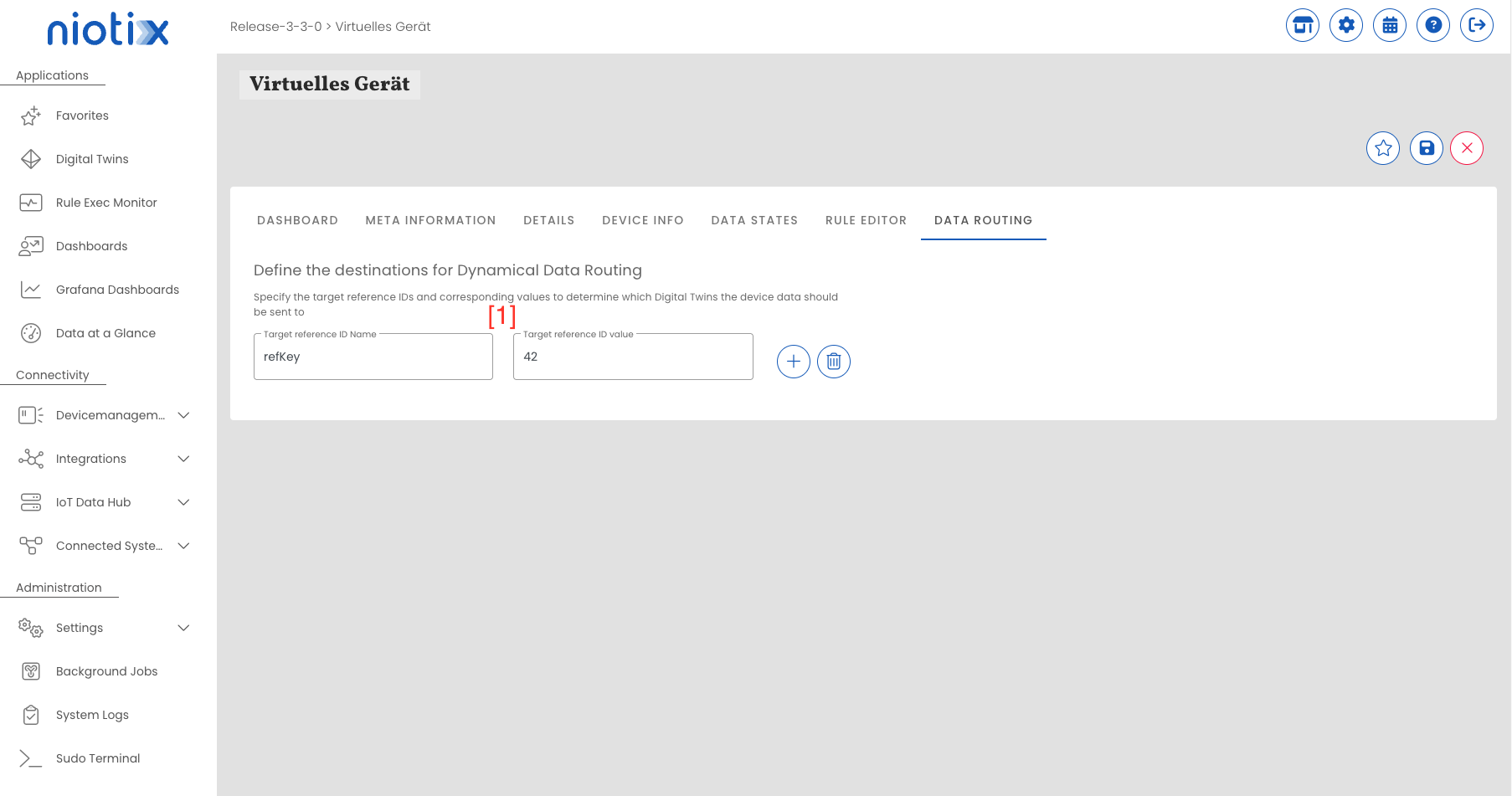
Configuring Routing in the Virtual Device
To forward data to one or more Digital Twins, the target is defined in the “Data Routing” tab [1].
Configuring Routing and Datastates in the Digital Twin
To forward data to one or more Digital Twins, the target is defined in the “Data Routing” tab [1].
The datastates must match the structure of the _parsed datastates of the Virtual Device [2]. The source is set to Dynamical Data Routing accordingly.